








According to Growth Market Reports, the global Fixed Satellite Services (FSS) market size reached USD 22.7 billion in 2024, demonstrating steady expansion driven by increasing demand for high-capacity communications, especially in remote and underserved regions. The market is expected to grow at a CAGR of 5.3% from 2025 to 2033, reaching a forecasted value of USD 36.1 billion by 2033. This robust growth trajectory is underpinned by technological advancements in satellite communications, rising adoption across diverse industry verticals, and the growing need for reliable connectivity in both developed and emerging economies.
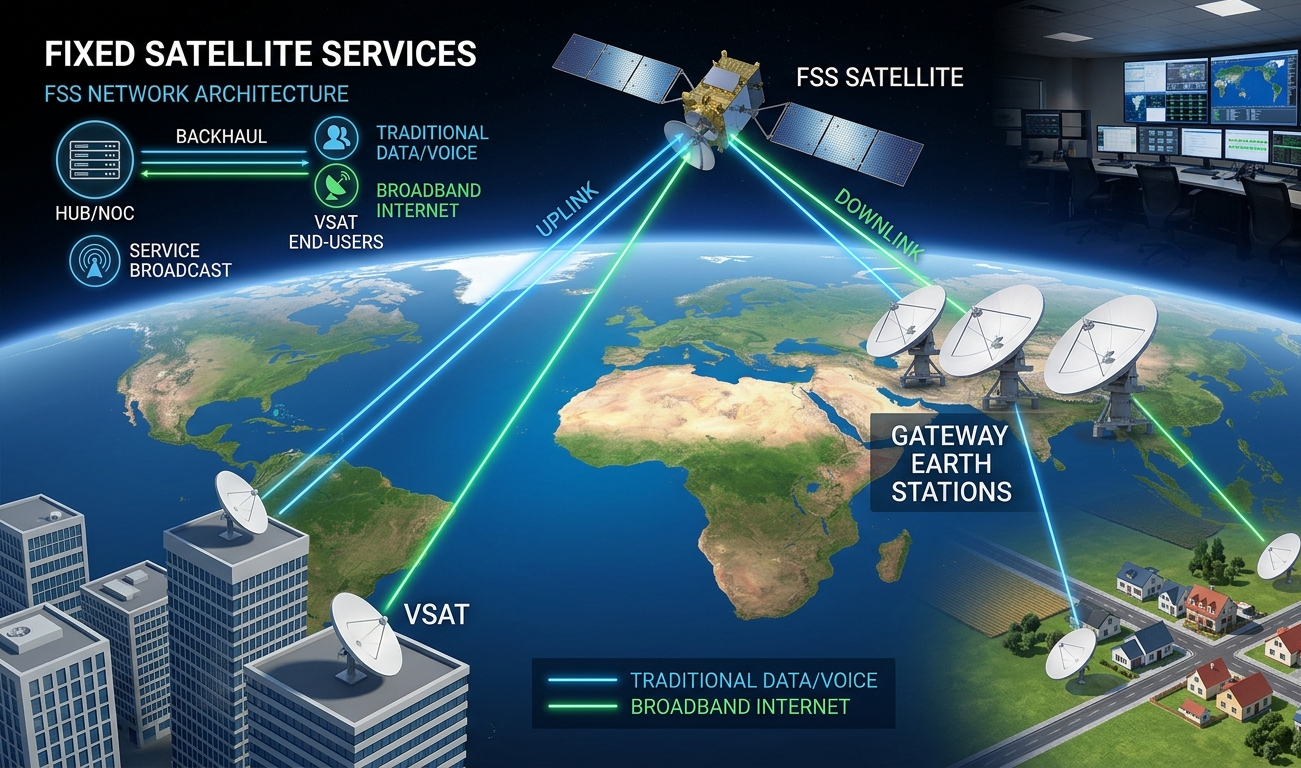
The Fixed Satellite Services (FSS) Market plays a critical role in the modern communications ecosystem by enabling reliable connectivity across vast geographic regions where terrestrial networks remain limited, expensive, or impractical to deploy. Fixed satellite services involve the transmission of voice, video, and data between fixed ground stations through communication satellites positioned in geostationary orbit (GEO), medium earth orbit (MEO), or low earth orbit (LEO). These services are widely used by enterprises, governments, telecom operators, broadcasters, maritime operators, aviation companies, and remote communities.
Growth Drivers
Rising Demand for Broadband Connectivity
One of the strongest drivers of the FSS market is the global demand for internet access. Millions of people still live in regions lacking fiber-optic or cellular infrastructure. Satellite broadband offers a practical solution by bypassing the need for extensive ground-based network deployment.
Governments and private organizations are increasingly using FSS systems to extend education, healthcare, financial services, and e-governance platforms to isolated communities. This widening use case continues to strengthen market demand.
Expansion of Enterprise Networks
Businesses operating in mining, oil and gas, agriculture, logistics, construction, and retail sectors often require secure connectivity in remote areas. Fixed satellite services allow these companies to maintain communication between headquarters and field operations.
Large enterprises also rely on satellite networks for redundancy. In case terrestrial systems fail due to outages or disasters, satellite links can maintain business continuity.
Growth in Broadcast and Media Distribution
Despite the rise of streaming platforms, satellite broadcasting remains a highly efficient method for distributing television and media content to large audiences. FSS satellites are widely used for direct-to-home broadcasting, contribution feeds, and regional content distribution.
High-definition and ultra-high-definition content formats require greater bandwidth, creating fresh revenue opportunities for satellite capacity providers.
Government and Defense Investments
National security agencies and defense organizations depend on secure, resilient communication systems. Fixed satellite services are often deployed for command centers, border monitoring stations, naval operations, and emergency response networks.
As geopolitical tensions and cybersecurity concerns grow, investment in independent and reliable satellite communication infrastructure is expected to remain strong.
Challenges Facing the Market
High Capital Requirements
Launching satellites and maintaining ground infrastructure require substantial investment. Satellite programs often involve long development cycles and financial risk, particularly if market demand shifts before launch.
Competition from Fiber and Mobile Networks
In urban and suburban areas, fiber-optic and advanced mobile networks can offer lower latency and competitive pricing. Satellite providers must therefore focus on underserved regions, resilience solutions, and specialized enterprise applications.
Regulatory Complexity
Spectrum allocation, orbital slot coordination, licensing, and international regulations can delay projects and increase operational complexity. Navigating these frameworks remains a challenge for both established and emerging providers.
Space Congestion and Debris Risks
The increasing number of satellites in orbit raises concerns around collision avoidance and long-term sustainability. Operators must invest in tracking systems and responsible mission planning.
Future Outlook
The future of the Fixed Satellite Services Market appears highly promising as global connectivity becomes a strategic necessity rather than a luxury. Demand for always-on communications, remote work enablement, digital inclusion, and resilient infrastructure will continue to support growth.
Emerging use cases such as smart agriculture, offshore automation, connected transportation corridors, telehealth expansion, and remote industrial monitoring are expected to generate new revenue streams. Furthermore, the convergence of satellite, cloud computing, and AI-driven network management will make services smarter and more responsive.
As satellite technology becomes more efficient and affordable, FSS providers will increasingly move beyond bandwidth sellers to become full-service digital connectivity partners.
Competitive Landscape
Prominent companies operating in the market are:
- SES S.A.
- Intelsat S.A.
- Eutelsat Communications S.A.
- Telesat Canada
- EchoStar Corporation
- Thaicom Public Company Limited
- Sky Perfect JSAT Corporation
- Hispasat S.A.
- Arabsat
- AsiaSat (Asia Satellite Telecommunications Company Limited)
- China Satellite Communications Co., Ltd. (China Satcom)
- Viasat Inc.
- Gazprom Space Systems